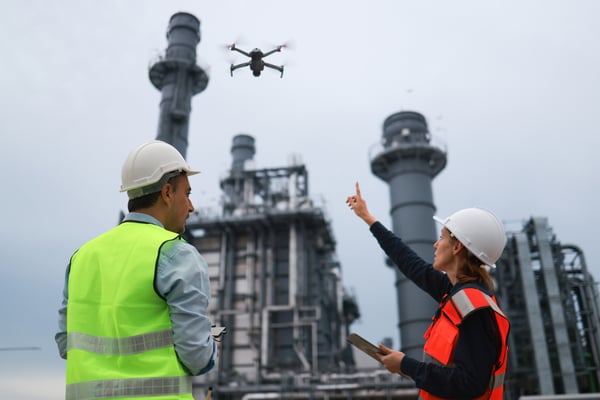
What Is Drone Interception?
Drone interception is the process of responding to a drone that may pose a safety, security, or operational concern. Depending on the situation and the authority of the organization involved, interception can include locating and approaching the drone operator, coordinating with law enforcement, restricting access to an area, or, for agencies with the appropriate legal authority, taking action against the aircraft itself.
The important distinction is that drone interception does not always mean physically disabling or bringing down a drone.
Effective interception begins with understanding what is happening in the airspace. Before security teams can determine how to respond, they need to know what type of drone is present, where it is flying, where it came from, who is operating it, and whether its behavior represents a threat.
That makes drone detection and airspace intelligence a critical foundation for an effective interception strategy.
Drone Interception Starts With Airspace Awareness
Counter-UAS operations can generally be thought of as a progression from detection to tracking, identification, and ultimately mitigation.
Interception happens toward the end of that process, but the earlier steps are what make an effective response possible.
A security team that simply receives an alert that a drone is nearby may have very little information to act on. Is the aircraft authorized? Is it a recreational pilot who accidentally entered the area? Is it conducting legitimate commercial operations? Or is its behavior consistent with surveillance, contraband delivery, or other suspicious activity?
Modern drone detection systems can help provide that context, including:
-
Drone manufacturer and model
-
Current location and flight path
-
Altitude and speed
-
Home or launch location
-
Estimated operator location
-
Remote ID information
-
Historical flight activity
-
Previous activity within protected or sensitive airspace
Together, these data points help security teams move from simply seeing a drone to understanding the risk level and determining an appropriate response.
Intercepting the Operator May Be More Effective Than Intercepting the Drone
When people hear “drone interception,” they often imagine technology physically stopping an aircraft in flight.
In practice, locating the person controlling the drone is the most valuable way to address unauthorized activity.
When a drone hovers over a secure facility, the operator is often somewhere nearby. If a detection platform can identify that operator's location, security personnel can work with law enforcement partners to apprehend and question the operator.
This gets you straight to the source of the problem. Bringing down an aircraft does not necessarily prevent a determined operator from launching another drone. Identifying the person responsible creates an opportunity to investigate the activity, determine intent, collect evidence, and prevent them from flying overhead again. It also provides a visible warning to the community that unauthorized drone flights can have real-world consequences.
This approach has practical applications at correctional facilities, critical infrastructure, government sites, stadiums, and other sensitive locations where unauthorized drones can create security or operational concerns.
What Does Drone Interception Look Like in Practice?
Typically, the first step is an alert from your drone detection system, which alerts security personnel to the aircraft. Airspace intelligence can then help determine where the drone is flying, whether it has previously appeared in the area, and where its operator may be located. Security personnel can use that information to assess the situation and coordinate with law enforcement.
One example comes from a correctional facility in Beaumont, Texas. After recurring drone activity associated with contraband delivery, detection data identified a drone launched from a location southeast of the facility. Local law enforcement partners were provided information about the operator's location and were ultimately able to find the operators with the drone still in flight and the controller in hand.
The result illustrates an important principle of drone interception: actionable airspace intelligence can enable responders to address unauthorized drone activity at its source.
Physical Drone Mitigation Is Different
Some counter-UAS capabilities are designed to directly affect an aircraft. These types of mitigation can include technologies intended to disrupt, disable, capture, redirect, or otherwise stop a drone.
However, the authority to physically mitigate drones is limited.
That distinction matters for organizations developing a drone security program. Purchasing detection technology does not automatically give an organization the authority to interfere with an aircraft, and a security plan should not assume that physically stopping a drone will always be an available response.
Instead, organizations should understand what actions they and their law enforcement partners are authorized to take and build response procedures around those authorities.
For many organizations, the most immediately actionable capabilities are therefore detection, identification, evidence collection, operator location, and coordination with appropriate authorities.
Good Interception Depends on Good Threat Discrimination
Not every drone should trigger the same response.
Low-altitude airspace increasingly includes recreational pilots, commercial operations, public safety drones, infrastructure inspections, delivery operations, and an organization's own aircraft. Treating every detection as a threat can quickly overwhelm a security team.
Effective interception requires threat discrimination: the ability to distinguish routine or authorized operations from activity that deserves further investigation.
Historical data can be especially useful here. A drone that briefly passes near a facility once may represent a very different situation from the same aircraft repeatedly approaching a sensitive location, flying unusual routes, operating at unusual times, or appearing in connection with other suspicious behavior.
Patterns of activity provide context. And context allows organizations and their law enforcement partners to make better decisions about when intervention is appropriate.
Building a Drone Interception Strategy
Organizations should think about interception as part of a broader airspace security program rather than as a standalone technology.
That starts with policy.
Security leaders should understand the risks they are trying to address, determine what information responders need, identify who should receive alerts, establish procedures for escalating incidents, and understand when law enforcement or other partners should become involved.
Those procedures can then inform the technology requirements.
A comprehensive approach may include persistent drone detection, automated alerts, historical flight information, operator-location data, reporting capabilities, integrations with existing security operations systems, and established relationships with law enforcement.
Most importantly, teams should answer a basic question before an incident occurs: “Once we detect a concerning drone, what are we going to do next?”
Having that answer documented ahead of time allows detection data to become operational intelligence rather than simply another security alert.
From Drone Detection to Effective Response
Drone interception is not simply about stopping an aircraft.
It is about giving security teams enough information to understand an incident and take an appropriate, lawful response.
For some authorized agencies, that response may eventually include direct mitigation of the aircraft. For many organizations, however, the most effective response may be identifying a suspicious flight, locating the operator, documenting patterns of activity, sharing evidence, and enabling law enforcement to intervene.
Modern airspace security therefore requires more than the ability to see that a drone is present. It requires persistent awareness, threat discrimination, historical context, and actionable intelligence that connects detection to response.
Solutions like SkySafe help organizations build that operational picture by providing real-time and historical visibility into drone activity, including flight paths, aircraft information, operator-location data, alerts, and reporting. With better information about what is happening above and around a facility, security teams can respond more quickly, coordinate more effectively, and make better-informed decisions when drone activity requires action.